In chemistry class we are learning Convection is the movement of molecules within fluids etc. It cannot take place in solids, since neither bulk current flows or significant diffusion can take place in solids.Convection is one of the major modes of heat transfer and mass transfer.
Tuesday, March 23, 2010
Convection
Friday, February 12, 2010
Combustion
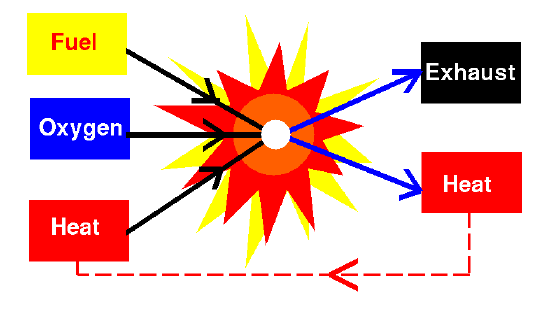
Combustion or burning is the sequence of exothermic chemical reactions between a fuel and an oxidant accompanied by the production of heat and conversion of chemical species. The release of heat can result in the production of light in the form of either glowing or a flame.
Thursday, February 11, 2010
Chemical Reactions
Five reaction types:
- Synthesis- two elements combining into a compound
- Decomposition- a compound being separated into elements
- Single Replacement- metal/hydrogen/halogen switches with metal/hydrogen/halogen
- Double Replacement- the cations swap anions
- Combustion - heat is produced
Polyatomic ions
As we move further in Chemistry class we know polyatomic ions are very important.A polyatomic ion, also known as a molecular ion, is a charged opns composed of two or more atoms covalently bonded or of a metal complex that can be considered as acting as a single unit in the context of acid and base chemistry or in the formation of salts. The prefix poly- means many in Greek, but even ions of two atoms are commonly referred to as polyatomic. In older literature, a polyatomic ion is also referred to as a radical, and less commonly, as a radical group.
Stoichiometry
In Mr.Olsen's chemistry class we are learning about stoichiometry. Stoichiometry is the calculation of quantitive (measurable) relationships of the reactants and products in a balanced chemical reaction. It can be used to calculate quantities such as the amount of products that can be produced with given reactants and percent yield (the percentage of the given reactant that is made into the product).
Thursday, February 4, 2010
Acids and Bases
Properties of Acids: Taste sour, React with active metals to produce H2, React with carbonates to produce CO2, Neutralize bases, forming salts, found in many fruits and foods.
Properties of Bases: Taste bitter, Are slimy to the touch, Neutralize acids, forming salts, Found in many cleaning solutions.
Thursday, January 7, 2010
Like Dissolves Like
In class we are learning about solutes and solvents. Solutes can be dissolve in solvents is one thing we have learned. Dissolving is to cause a solute to pass into solution.
Like dissolves Like, This means that substances are more likely to dissolve in other substances with similar chemical properties. It is most often used when discussing polar and nonpolar solvents. For example, oil will not dissolve in water because oil is nonpolar and water is polar. Basically, a polar solvent will generally dissolve polar solutes and sometimes ionic solutes, and a nonpolar solvent will generally dissolve nonpolar solutes.
Subscribe to:
Posts (Atom)